







Do Manual Handheld Desalination Devices Really Work?
A manual handheld desalinator turns seawater into drinking water with a hand pump and a small reverse osmosis membrane — no battery, no fuel, no installation. It is the device you want in a life raft or an emergency pack, and it genuinely works. What it cannot do is supply a crew, a camp or a household, because its output is measured in hundreds of millilitres to two litres per hour of pumping.
So the useful question is not whether handheld units work. It is where the boundary sits between a manual device and an electric portable water maker — and that boundary is set by output, by headcount and by whether power is available on site.
🔧 How a Manual Handheld Desalinator Actually Works
A hand-operated piston or diaphragm pump raises seawater to the pressure a small RO membrane needs. The membrane rejects dissolved salt and the permeate is collected as drinking water. The whole unit is a pump, one or two small elements, tubing and a collection bottle, which is why it can weigh a few hundred grams and be stowed in a pack or a life raft.
The limitation comes from the same source as the advantage. Human arms produce limited pressure and limited flow, so the membrane area has to be small, and output lands somewhere between a few hundred millilitres and one to two litres per hour depending on the operator and the sea state. Sustained pumping is tiring work: two people sharing a unit keep going longer than one, which is worth planning for in an emergency kit.
⚡ Output: The Number That Decides the Use Case
A person needs roughly 2 to 3 litres of water a day for drinking and food preparation, more in heat. At one litre per hour of pumping, that is two to three hours of hard work per person per day. For a group of four, the arithmetic stops making sense at eight to twelve hours of pumping every day — which is exactly why handheld devices are specified as survival equipment rather than as a water supply.
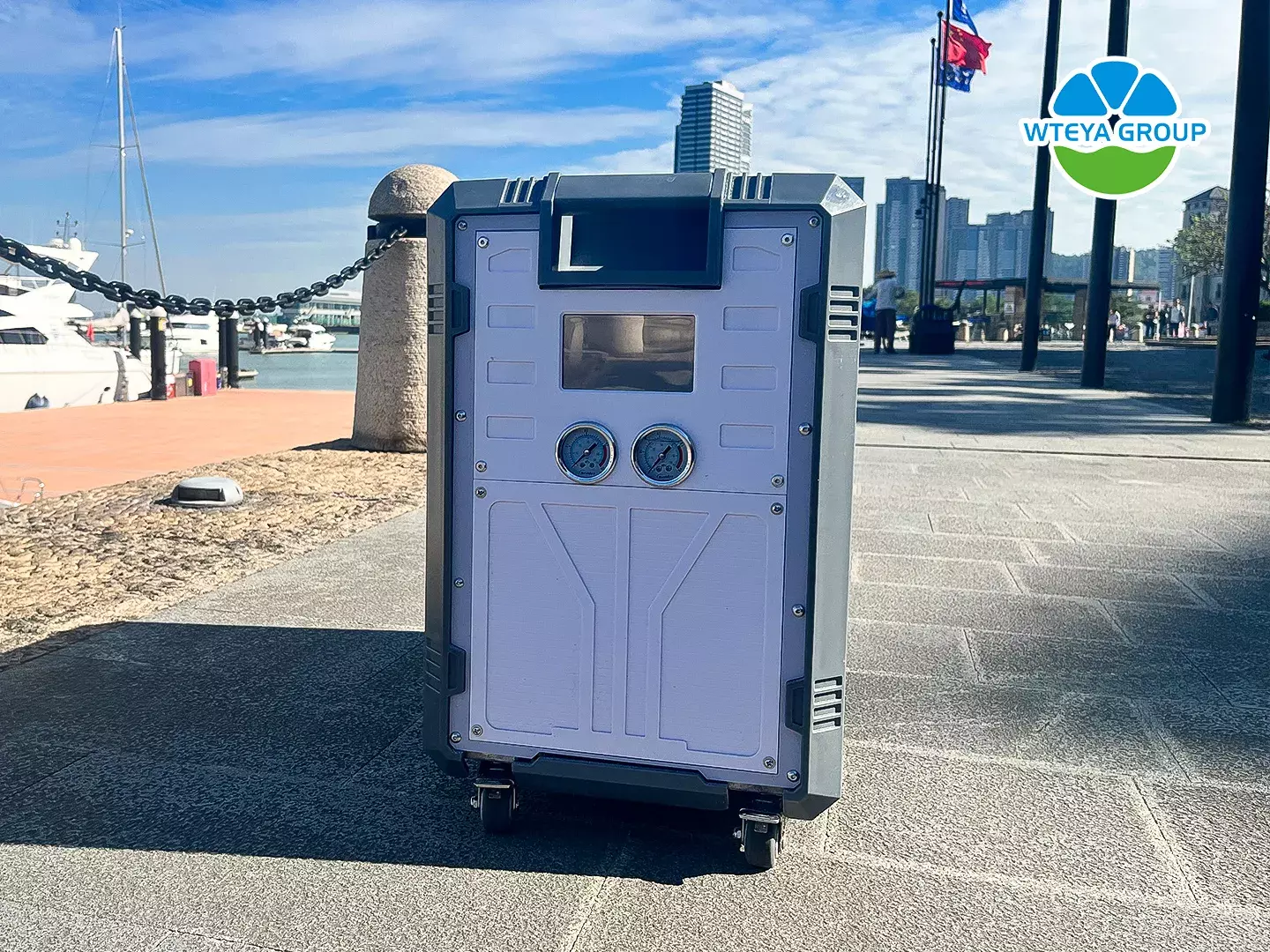
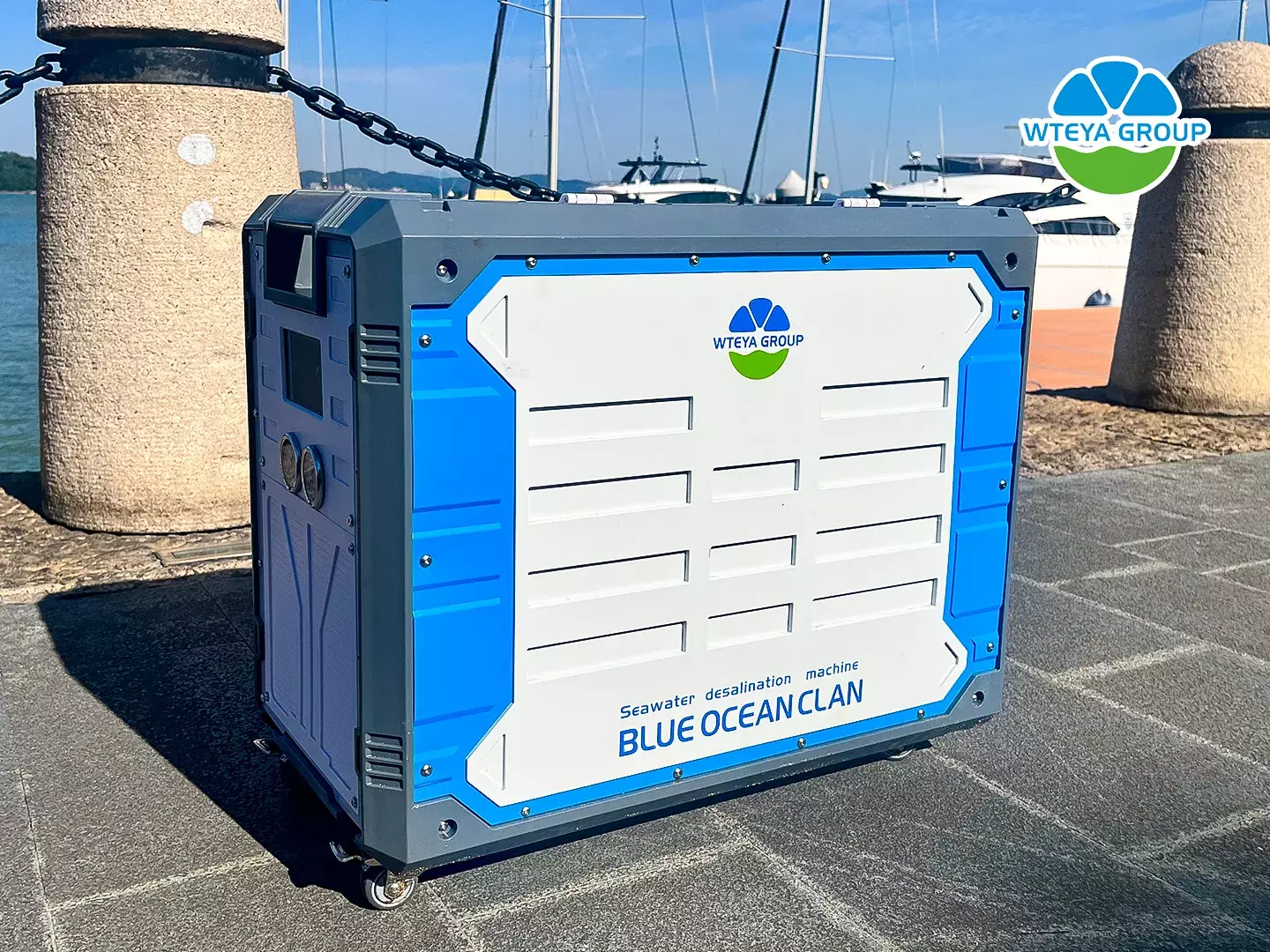
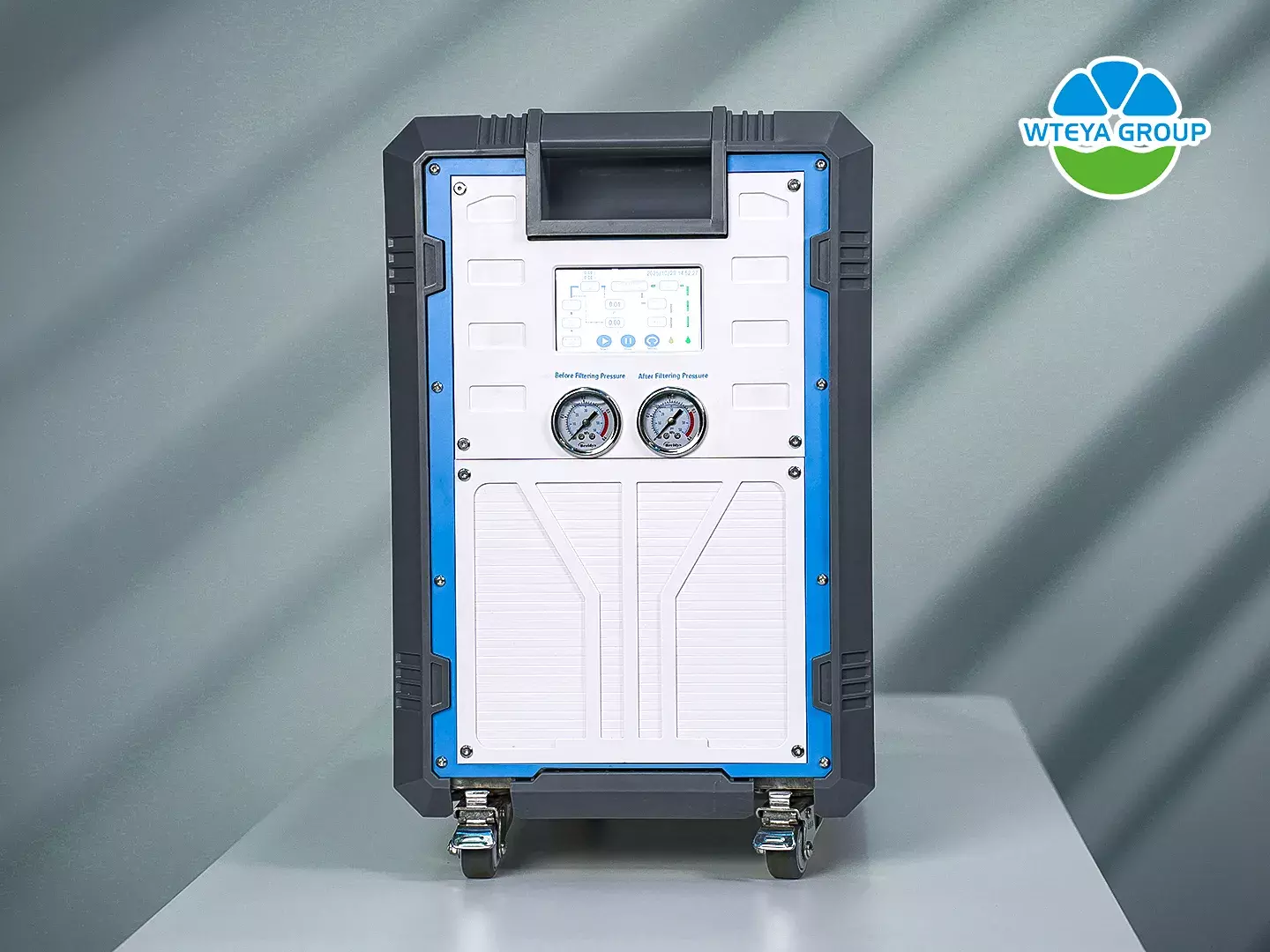
An electric portable unit closes that gap. The SW-4021 platform we build produces 300 GPD, about 1,200 litres per day or 50 litres per hour, from a 1.35 kW plunger pump. That is roughly a hundred times the hourly output of manual pumping, and it runs unattended once started.
🚤 What an Electric Portable Water Maker Adds
The electric machine keeps a stable 100 bar at the membrane, so salt rejection stays above 99% regardless of who is operating it. Product water passes a 254 nm UV stage and is ready to drink. The platform accepts 220 V or 24 V supply and can run from solar, which matters on a vessel or at a camp where a generator is not running all day.
Configurations for continuous duty are described on our seawater desalination plant and reverse osmosis system pages, and trailer-mounted versions for site work on our mobile water treatment plant page.
The trade-off is maintenance. An electric unit has pre-filters to wash, oil to change on the hour meter and a membrane to preserve when idle — routine work, but work. A manual unit has almost no service requirement until the element finally fouls, which is another reason it belongs in the emergency kit and not in the galley.
💡 Three Questions That Settle the Choice
How many people, for how many days? One or two people for one to three days is handheld territory. A crew, a camp or a site that needs water every day for weeks needs an electric machine, because the daily pumping hours become the constraint rather than the equipment price.
Is there power? A 24 V battery bank or a small solar array is enough to run a portable electric unit, and both are common on vessels and at remote camps. If there is no power and no prospect of it, the manual device is not a compromise — it is the only option that works.
What does failure cost? Where water is the primary supply, a handheld unit is a poor primary and an excellent backup. Many of the vessels and remote sites we supply carry both: the electric machine for daily production, a manual device sealed in the survival locker for the day the pump or the power fails.
📊 Handheld vs Electric Portable: Side by Side
Output: a few hundred millilitres to 2 L per hour by hand, against 50 L per hour from a 300 GPD electric unit.
Power: none required, against 1.35 kW at 220 V or 24 V, solar-compatible.
Water quality: both rely on RO; the electric unit holds constant pressure, so rejection stays above 99% and the UV stage can be included.
Best use: life rafts, survival packs, single-person carry, backup duty, against fishing boats, yachts, island camps, construction sites and disaster response.
Service: almost none until the element fouls, against scheduled pre-filter washing, oil changes and membrane preservation.
🛠️ If You Carry Both, Protect the Membranes
Two habits decide how long either device lasts. First, never let a membrane dry out with salt inside it: flush with fresh water after every use, and for storage longer than three days preserve the element in 1–1.5% food-grade SMBS solution, renewing the solution every 30 days. Second, keep sediment out of the pump: a rinsed pre-filter cartridge is far cheaper than a scored plunger or a fouled element.
❓ Related FAQs
🔗 How Much Does a Portable Seawater Desalination Machine Cost?
🔗 Can a Portable Seawater Desalination Machine Run on Solar Power?
🔗 What Is the Service Life of a Portable Desalination Unit?
Schedule a video call with our engineers to explore your options.
📲 WhatsApp: +86-1800 2840 855
📧 Email: info@wteya.com
🌐 Website: www.wteya.com

Previous: What Is the Service Life of a Portable Desalination Unit?
Next: No More