







WTEYA Ships 10 SWRRO4021 Units to Puerto Rico
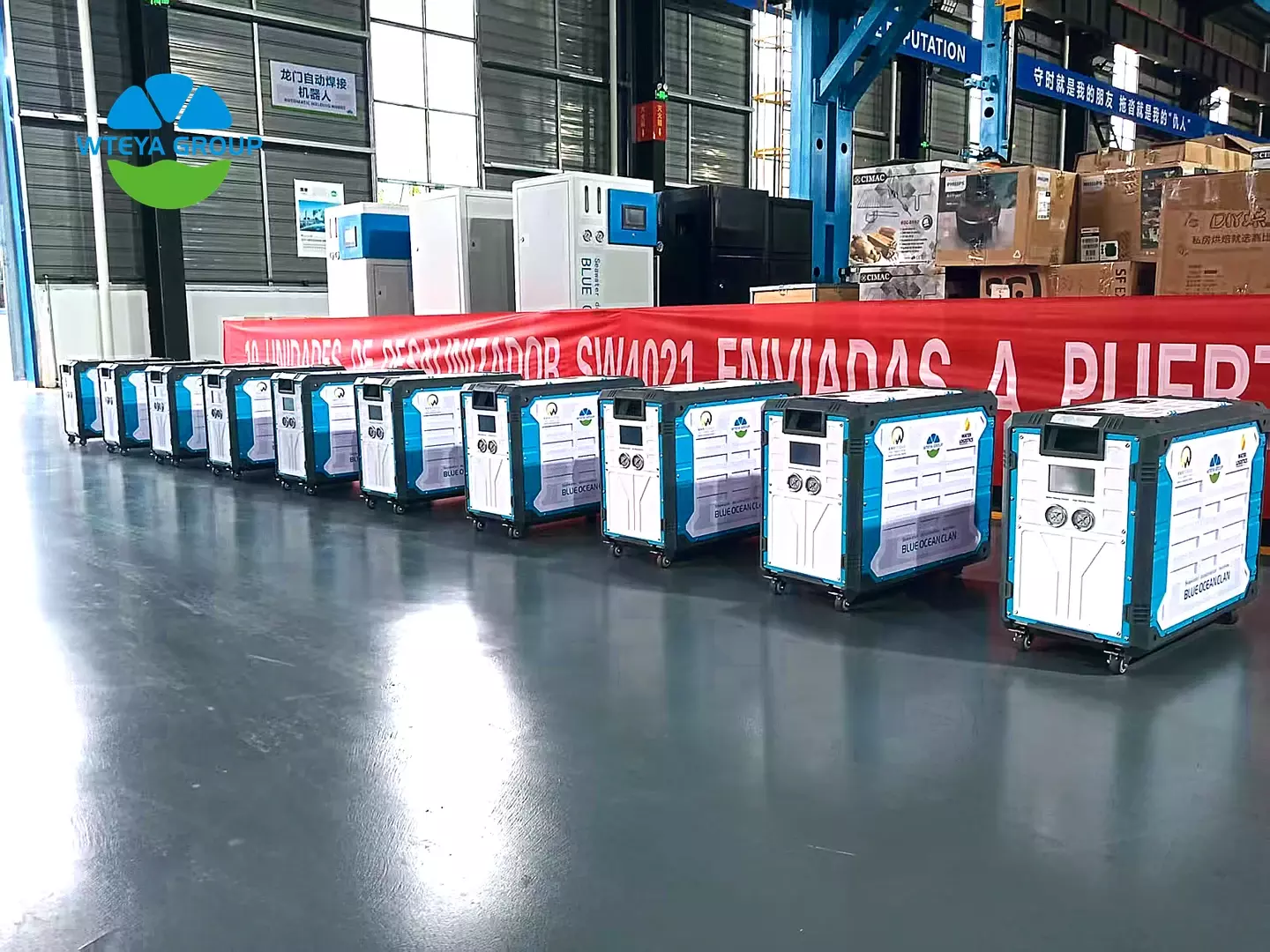
WTEYA has completed production and export packing of ten SWRRO4021 portable desalination units for a customer in Puerto Rico. The fleet left the company's manufacturing base this week in ten wooden export crates, one complete machine per crate, and will be commissioned across coastal communities that rely on seawater and brackish wells for drinking water. The SWRRO4021 is a self-contained seawater reverse osmosis machine built into a blue-and-white enclosure on casters, with an LCD panel that reports feed pressure, permeate flow and product water quality. Because every unit arrives pre-assembled, pre-wired and factory-tested, a portable desalination unit can be put into service within hours of unloading rather than weeks.
⚙️ Inside the SWRRO4021 Portable Desalination Unit
Each SWRRO4021 packs a complete seawater reverse osmosis train into a single mobile frame: intake and pretreatment, chemical dosing, a high-pressure pump, the membrane array, instrumentation and a control cabinet. The enclosure is split into an equipment bay and a service bay, so an operator can reach cartridges, gauges and valves without dismantling the machine. The blue-and-white housing is not cosmetic — it carries the lifting points, the ventilation path for the pump motor and the recessed panel that keeps the display readable in direct sun.
All ten units were assembled, pressure-tested and run-tested at the factory before crating, so site work is limited to four connections: intake, brine discharge, product water and power. No concrete plinth, no dedicated building and no specialist rigging crew are required. The chassis rides on four heavy-duty casters with locking brakes, which means two people can reposition a unit on a concrete pad and a single operator can run it once the hoses are connected.
The LCD interface shows operating pressure, flow rate, recovery and product salinity in real time, and it records fault codes so a local technician can diagnose a tripped pump or a fouled membrane without calling an engineer. A machine of this class is only useful in an emergency if the people on site can read it, so the control logic deliberately exposes the four numbers that matter instead of burying them in a service menu.
🏝️ Built for Island Desalination and Emergency Water Supply
Island desalination projects rarely fail on membrane performance. They fail on logistics. A single centralised desalination plant serving scattered communities needs roads, a stable grid connection and a distribution network that may not survive a storm. Spreading capacity across ten small machines changes that risk profile: if one unit is down for maintenance, nine keep producing, and capacity can be moved to wherever demand is highest that week.
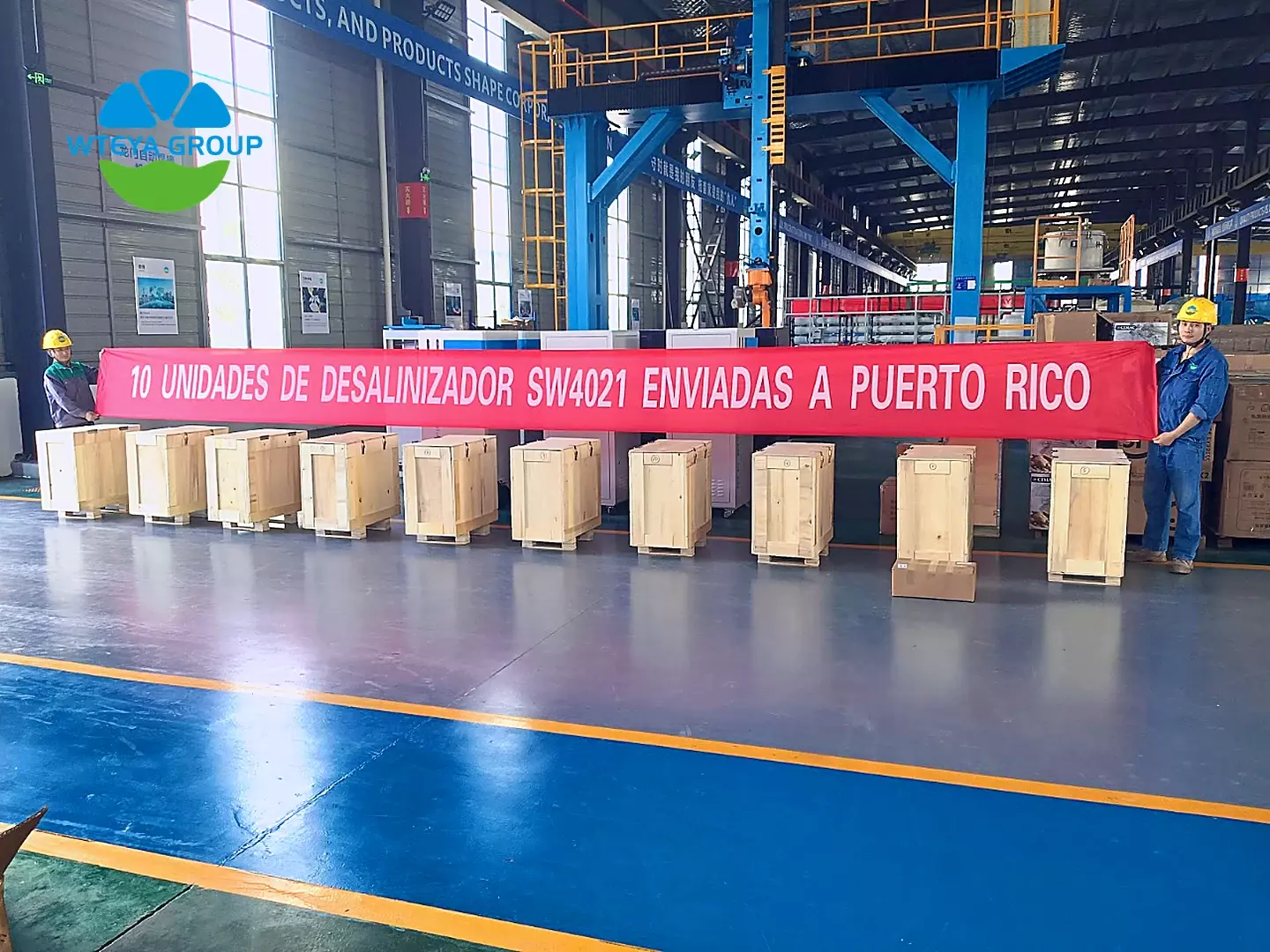
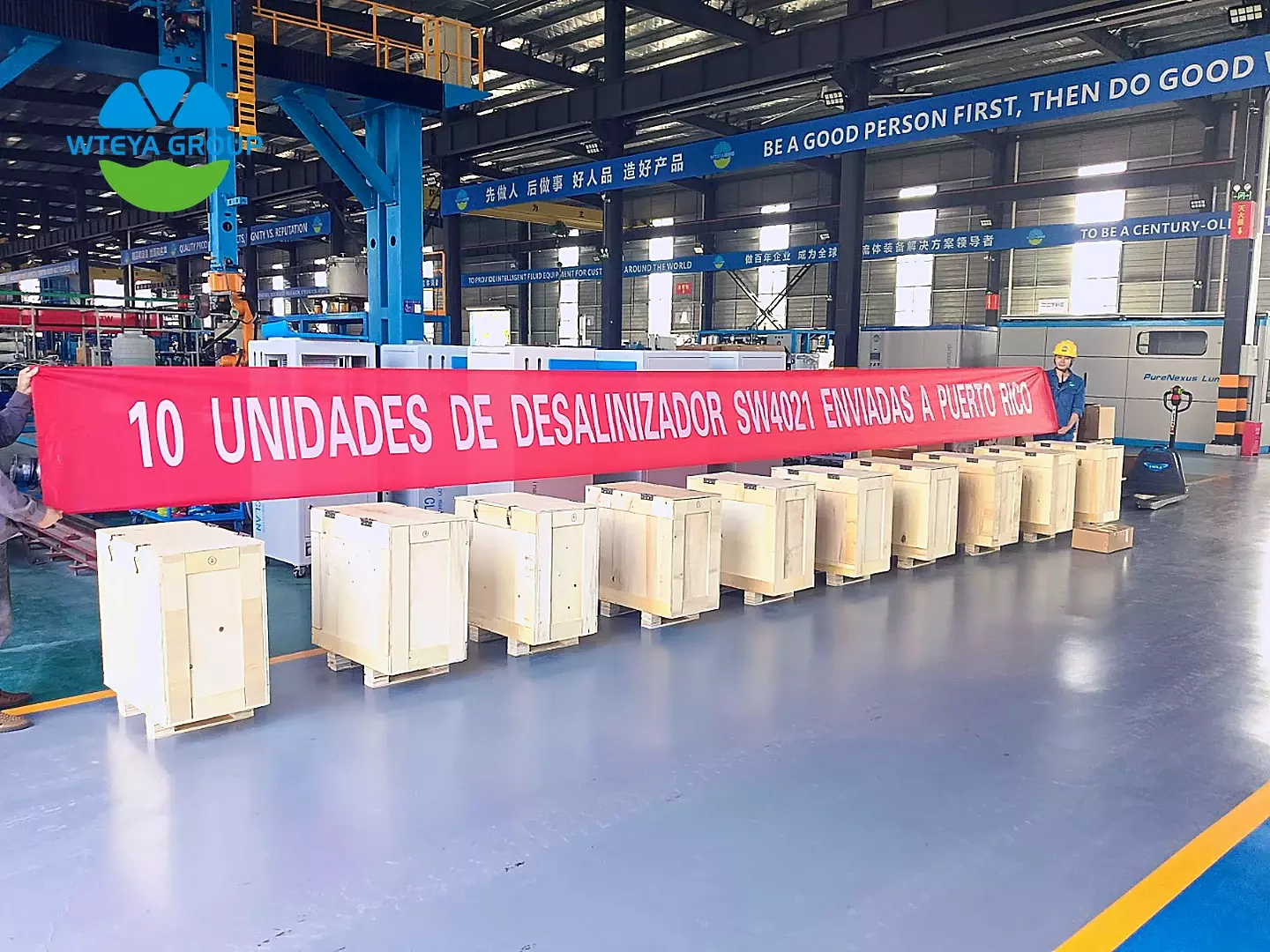
The SWRRO4021 is dimensioned to travel. Each unit fits a standard wooden export crate, ten crates load into a single 20-foot container, and nothing heavier than a forklift is needed at destination. For emergency water supply operations that means equipment can be pre-positioned at municipal depots before hurricane season and trucked to a coastal site after landfall, without waiting for a crane that is already booked by somebody else.
The machines accept seawater feed as well as brackish well water, which matters on an island where saltwater intrusion moves further inland every year. Operators can switch source without changing the membrane configuration, and the pretreatment stage is sized for the silt and algae load that follows heavy rain — the exact conditions in which a desalination plant is most needed and least forgiving.
⚡ Low-Energy Operation and Solar Powered Desalination Readiness
Energy is the largest operating cost in any reverse osmosis system, and on an island it is also the least reliable input. The SWRRO4021 uses a high-pressure pump driven by a variable frequency drive together with an energy recovery device, so the motor follows the actual feed salinity instead of running at a fixed duty point. When the feed is cleaner after heavy rain, the controller reduces pump speed and power draw falls with it.
The electrical design accepts a wide input window and can be fed from a diesel generator, the local grid, or a photovoltaic array with battery storage. WTEYA supplies solar powered desalination configurations for sites where the grid is absent or unstable, and the same control cabinet manages the changeover between sources. For a community centre or a response depot with daytime-only demand, an array sized to the pump load can cover most of the daily production, which removes the fuel convoy from the logistics chain entirely.
🔧 Production and Quality Control Behind the Shipment
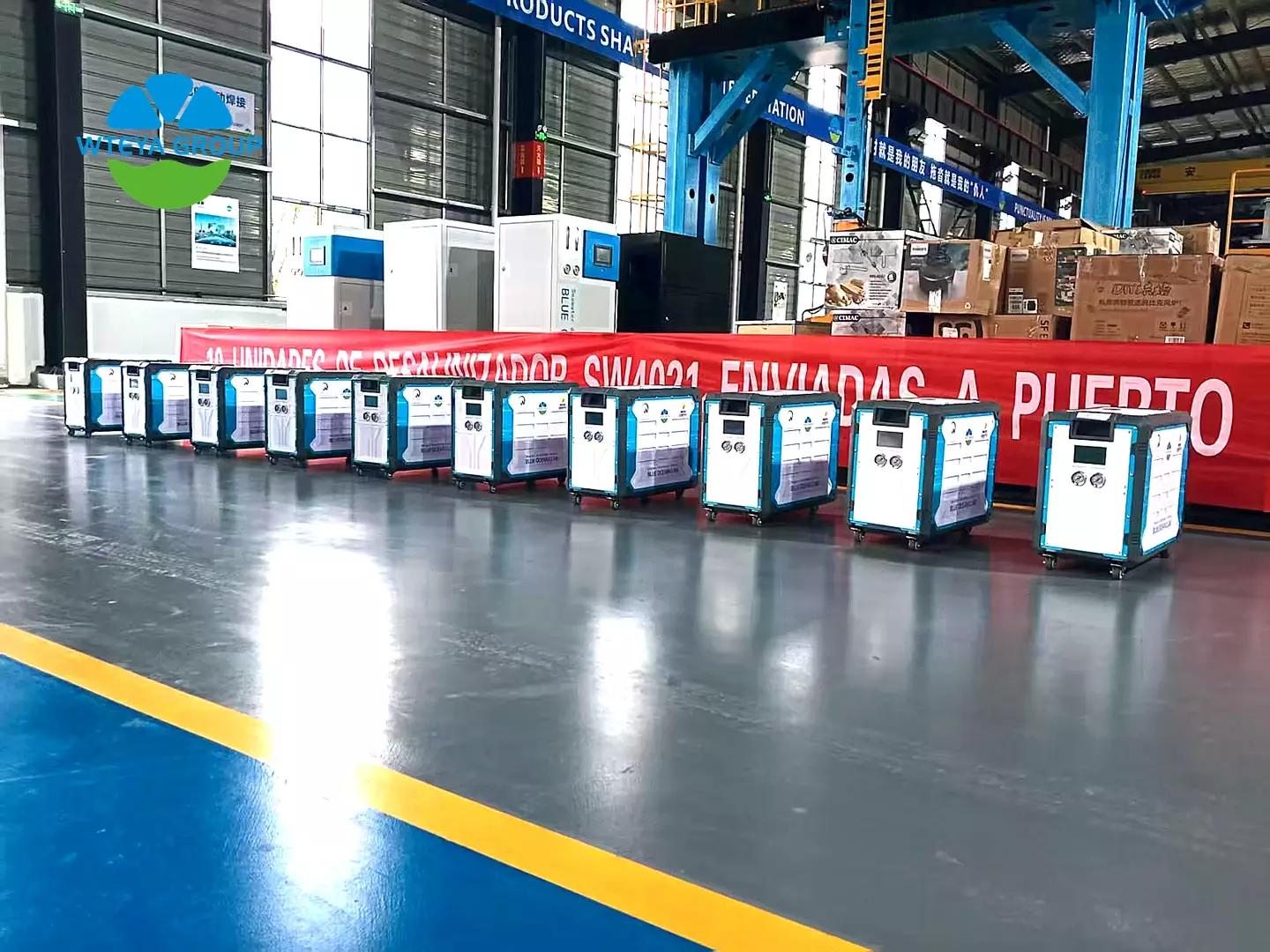
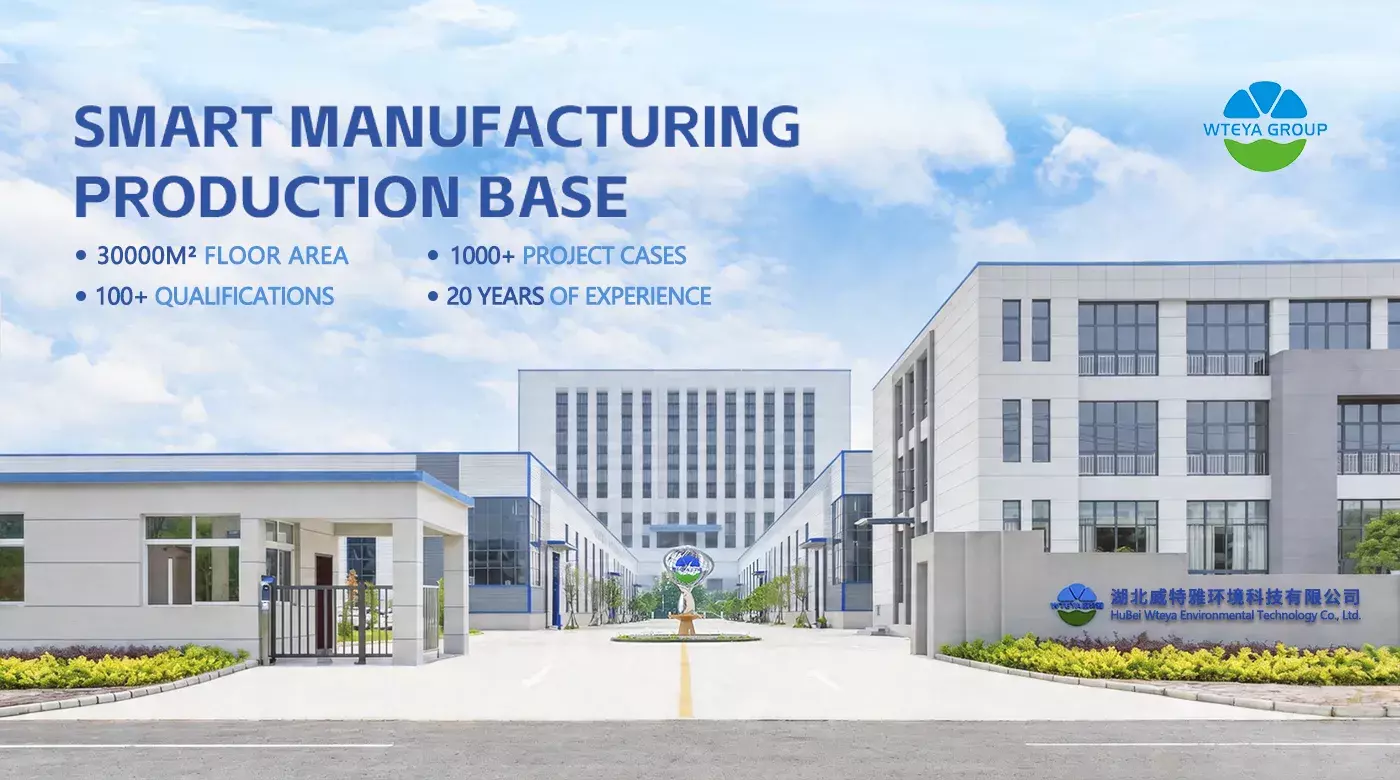
The ten units were built as a single batch, which is the simplest way to keep a fleet identical. Skids are cut and welded in-house on automatic welding gantries, then move through assembly, electrical wiring and panel programming on the same line. Building a fleet in one run means the tenth machine is wired exactly like the first, and a spare part pulled from the warehouse fits any unit on the island.
Every machine passed a hydrostatic pressure test on the membrane housings, a low-pressure leak check on the piping, and a full run test on chlorinated feed water before crating. Product water conductivity was recorded for each unit and the results travel with the machine in its documentation pack. The batch was released only after all ten units met the same conductivity and pressure-holding criteria, because a fleet that behaves differently unit by unit becomes the customer's maintenance problem within a year.
For this order the factory also produced Spanish-language operating labels and a startup checklist, and the dispatch team photographed the completed row of units with the customer's shipment banner before loading. The crates are braced for ocean freight and marked for a single discharge port, so the receiving team can identify each machine without opening every box.
❓ Frequently Asked Questions
How quickly can an SWRRO4021 unit be commissioned on site?
Because the unit ships pre-assembled and pre-tested, commissioning usually takes hours rather than days: connect the intake, brine and product lines, connect power, flush the membranes and start production. A local technician can complete the procedure using the startup checklist supplied with each machine, and remote support covers the first run if required.
Can the units run on solar power?
Yes. The control cabinet accepts AC-coupled or DC-coupled solar input through an inverter and battery bank, and the pump drive ramps with available power instead of tripping on a voltage dip. For daytime operation the array is sized to the pump load plus ancillary demand.
What maintenance does a portable desalination unit need?
Daily readings of pressure, flow and conductivity; cartridge replacement when differential pressure rises; membrane cleaning when normalised flow drops; and periodic inspection of pump seals. All consumables are standard items rather than proprietary parts, which keeps a distributed fleet serviceable by local technicians.
Schedule a video call with our engineers to explore your options.
📲 WhatsApp: +86-1800 2840 855
📧 Email: info@wteya.com
🌐 Website: www.wteya.com
Previous: WTEYA 4021 Portable Desalination Enters Four New Markets Across the Americas and Europe
Next: No More